The Culture of Combat in Latin America

Author: François Soulard. Collection edited by Raphaël Chauvancy.

An expanded version translated into Spanish is due to be published in March 2026 under the title “Combatir en el Nuevo Mundo” (see above).

The conquest of a continent, the Spanish Golden Age, a generative empire, independence movements and ideological struggles… Ultimately, Latin America has never stopped fighting. From the fall of the Aztec and Inca empires to the wars of liberation in the 19th century, this continent was forged in the clash of wills and worldviews.

More than elsewhere, violence has not only taken the form of armies and battles: it has also been symbolic, cultural, spiritual, and economic. This is what François Soulard analyzes in this essay, where military history intersects with anthropology and geopolitics. He deciphers the cultures of combat that have shaped Ibero-American societies. This book provides an understanding of how the continent has been permanently marked by power relations and the spread of conflicts between great empires.

Available from VA éditions

Format: French, 15×21, 140 pages, released in September 2025.
A new era of information warfare in Latin America

Author: François Soulard.

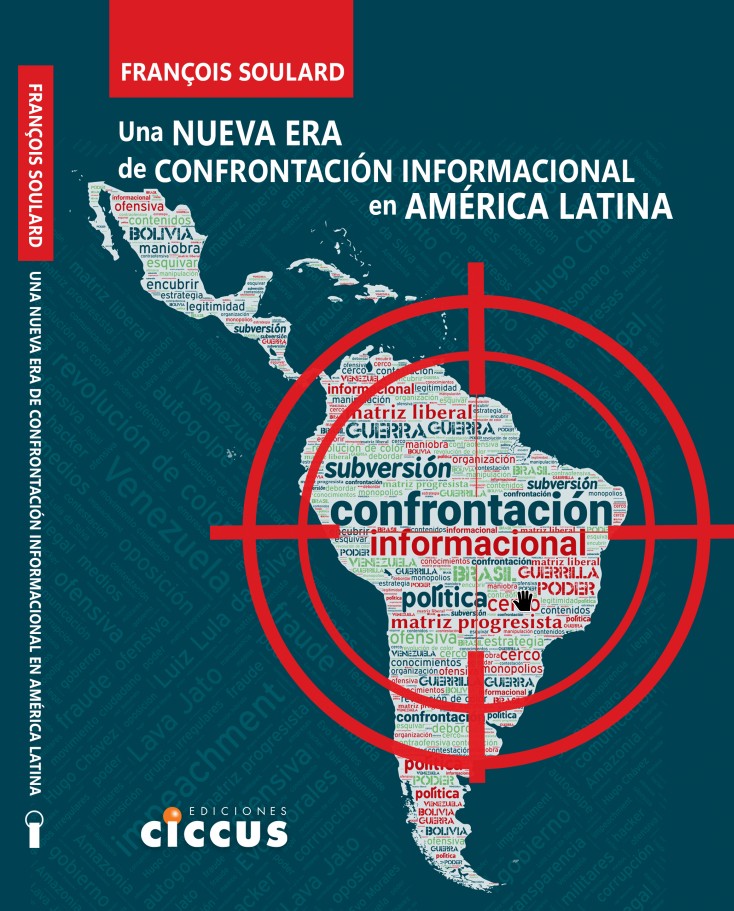
Latin America has entered an era of high-level, high-intensity information warfare. While this reality is not new, the emergence of the progressive wave in the late 1990s marked a real strategic turning point. Three case studies on Venezuela, Bolivia, and Brazil are presented in the book, scrutinizing the strategies and methods deployed in these three contexts as well as in the regional landscape.

The information war has unified the fields of confrontation. It is clear from the cases described that the legal, political, economic, and military dimensions are closely linked to information agendas. The latter have strategic and subversive implications in the region. They have changed the very face of politics and perpetuate protest movements on the continent. The use of information for conflict purposes is generating a new head-on clash in Latin American societies that needs to be studied in much greater depth.

Available from Ediciones CICCUS, Mercado Libre ou Busca Libre.

Format: Spanish, 288 pages, weight: 0.41 kg, height: 21.0 cm, width: 15.0 cm, thickness: 1.6 cm. ISBN: 978-987-693-962-1 Published in 2023.

Economic warfare in the 21st century

Translation into Spanish: François Soulard and Marina Pou. Preface: Iris Speroni.

Economic warfare in the 21st century revisits the economic conflicts that profoundly shape the international arena. It explains how states, businesses, and civil society clash, far beyond the traditional notion of competitive intelligence or business intelligence.

This book by Christian Harbulot takes a broad look at the situation in France and then shows how the United States, China, Japan, Germany, and other powers are establishing their geopolitical influence through a new form of economic warfare, motivated by the deployment of power.

Influence, information warfare, and intelligence are all part of this approach. The vision developed by the author, one of the leading international experts on the subject, is an essential starting point for understanding the reality of Ibero-American countries.

Available in Spanish from Ediciones CICCUS, Mercado Libre.

Format: 224 pages, weight: 0.36 kg, height: 21.0 cm, width: 15.0 cm, thickness: 2.0 cm. ISBN: 978-987-693-370-4, binding: BINDER, publication: 2025.

From Hegemony to the Decline of the West (Strategic Atlas)

Translated into Spanish and English by François Soulard and Marina Pou.

The author, Gérard Chaliand, traces the major stages in the geopolitical history of the West from the 19th century to the present day from a historical perspective. He highlights a new vision of the world, revealing it in all its complexity. Chaliand notes that Europe, which dominated the world from the late 18th century to 1914, no longer has the status of a political power and has relinquished all military sovereignty, as illustrated by Russia’s invasion of Ukraine. The demonstration of East Asia’s role in the origins of the shift in the balance of power is surprising, as is the United States’ inability over half a century to curb irregular wars. This marks the end of the Western monopoly on power, and others in Asia even go so far as to describe it as the end of the Western interlude (Kishore Mahbubani). An essential alternative version of the global history of the 20th and 21st centuries is thus emerging.

Available in French from Autrement (translated versions have not been published by the publisher).

Empires

Translation into Spanish: François Soulard. Preface: Heriberto Auel.

Empires have been a central feature of civilization over the last 6,000 years of history. They embody a form of domination exercised by one group of people over other populations of different ethnic or religious origins. Empires, like states, were built by the sword and maintained their power through force, the fear they inspired, and the splendor of their prestige.

The genesis of Latin America is closely linked to this phenomenon and resulted from the shift towards the recent form of overseas imperialism in the 15th and 16th centuries, after a long period marked by opposition between nomadic and sedentary societies in the Eurasian mass. In terms of expansion, the Spanish conquest of America is similar to Alexander the Great’s Anabasis or Genghis Khan’s vast Mongol empire in the 13th century. The historical legacy of empires is fundamental to geopolitical and strategic thinking. Byzantium, for example, disadvantaged by its geographical reality, forged a rich strategic culture that allowed it to endure for a millennium. China has survived the ages with remarkable strategic vigor, without relying on a dominant monotheistic religion unlike other empires. With the end of the last great territorial empire, namely the Soviet Union, the transformation of imperialism has accelerated and changed the strategic landscape.

This book by French-Armenian geostrategist Gérard Chaliand offers a unique historical overview. It focuses on the strategic capital left behind by past and emerging empires (China, Iran, the United States, Europe, Turkey, and Russia).

Why the West has stopped winning wars?

Translation to Spanish: François Soulard. Preface: Pedro Brieger.

Since the withdrawal from Vietnam, the military record of the United States and its Western allies has been undeniably negative: costly conflicts, mediocre military results, disastrous political consequences. Combining history, geopolitics, and field observations, Gérard Chaliand rigorously and honestly highlights the ingredients for victory and the current reasons for failure, particularly in the Middle East. His conclusion is clear: the United States and Europe no longer know how to win military wars.

During his long career as an academic and essayist, Gérard Chaliand has become one of the leading specialists on issues relating to the “Third World” and the “colonial world,” a category widely used to refer to the various national liberation struggles against the colonial powers that occupied almost the entire planet in the 1950s and 1960s. During those years, almost all African countries gained their independence, and in several regions of Asia, Africa, and Latin America, political processes were led by figures who attempted to build a path that was not aligned with the great powers and to escape the pattern of confrontation of the “Cold War” between the United States and the Soviet Union.

Author: Gérard Chaliand. Available from Ediciones CICCUS.

An English version is available in losing-wars.net.

Pages: 160, weight: 0.23 kg. ISBN: 978-987-693-739-9 Binding: BINDER Publication: 2018.